Skip to content
Narsimha Reddy Engineering College (NRCM) Hyderabad logo Atlantis Press, part of Springer Nature, proceedings publisher logo Web of Science indexing logo
Hosted by Narsimha Reddy Engineering College (NRCM), Hyderabad

ICCNOVA 2027: International Conference on Computing, Next‑Generation Opportunities, Vision & Advanced Technologies

ICCNOVA 2027 is a hybrid international conference in Hyderabad, India, on 4–5 March 2027 — a forum for researchers, academicians, technologists and industry leaders to present advances in computing and emerging technologies. Call for papers is open; accepted papers are considered for Atlantis Press (Springer Nature) proceedings.

4–5 March 2027 Hyderabad, India Hybrid Mode Submitted for Web of Science Indexing
0CONFERENCE DAYS
0TECHNICAL TRACKS
0PAPERS EXPECTED
0REVIEWS PER PAPER
Call for Papers Now Open  ·  Full paper deadline: 15 December 2026
Updates

ICCNOVA 2027 Latest News

Everything you need to know about publications, indexing and deadlines.

Publication

Proceedings Publication

All accepted and presented papers will be considered for publication in the open-access conference proceedings, Advances in Intelligent Systems and Research, published by Atlantis Press, part of Springer Nature, subject to the publisher’s review and publication policies. The proceedings will be published with an ISBN, and there is no restriction on the number of pages of the submitted papers, provided they meet the publisher’s formatting and quality requirements. Selected papers may also be invited for extension and consideration in relevant Web of Science-indexed journals, subject to the respective journals’ editorial review and acceptance policies.

Indexing

Indexing

All selected and accepted papers will be published in the conference proceedings Advances in Intelligent Systems and Research, published by Atlantis Press, part of Springer Nature. The published proceedings will be submitted for consideration for indexing in the Web of Science, subject to the applicable evaluation criteria and indexing policies.

Schedule

Important Dates

Full paper submission: 15 Dec 2026
Notification of acceptance: 30 Dec 2026
Registration deadline: 10 Jan 2027
Camera‑ready paper: 25 Jan 2027
Conference dates: 4–5 March 2027

All deadlines close at 23:59 IST (UTC+5:30). At least one author of every accepted paper must register and present the work — in person or online.

Submission

Paper Submission

Authors are invited to submit their original research papers through METEOR, an online manuscript submission and peer-review management system. The system facilitates paper submission, reviewer assignment, peer review, and tracking of manuscript status throughout the review process.

Paper Submission Link →
The Conference

About ICCNOVA 2027 – International Conference in Hyderabad

ICCNOVA 2027 — The International Conference on Computing, Next‑Generation Opportunities, Vision and Advanced Technologies — will be held on 4–5 March 2027 at Narsimha Reddy Engineering College (NRCM), Hyderabad, in hybrid mode. It brings together researchers, academicians, industry professionals, founders and innovators from across Asia and beyond to explore the frontiers of computing and advanced technologies.

The conference is a platform for meaningful exchange: keynote addresses by global technology leaders, hands‑on workshops, research paper presentations, startup pitch sessions and an exhibition of emerging innovations. Across 10 technical tracks and 125+ topics, ICCNOVA 2027 covers Artificial Intelligence and Generative AI, Data Science, Cybersecurity, Computer Networks and IoT, VLSI and Embedded Systems, Communication Engineering, Power Systems, Robotics and Automation, and emerging interdisciplinary technologies.

Accepted and presented papers will be considered for publication in the open‑access proceedings Advances in Intelligent Systems and Research, published by Atlantis Press, part of Springer Nature, subject to the publisher’s review and publication policies. The proceedings will carry an ISBN, and selected papers may be invited for extension and consideration in relevant Web of Science‑indexed journals, subject to each journal’s editorial review. Every submission receives at least three independent peer reviews.

“ICCNOVA 2027 will create a platform to meet like‑minded individuals, forge close‑knit connections, and engage with domain authorities.”

About the Institute

Narsimha Reddy Engineering College (NRCM) is a UGC Autonomous, NBA‑accredited and NAAC ‘A’ Grade institution, established in 2007 under the Jakkula Educational Society. Permanently affiliated to JNTUH and approved by AICTE, it offers UG and PG programmes across CSE, AI & ML, Cyber Security, IT, ECE, EEE, Mechanical, Civil and MBA.

The green campus offers modern classrooms, laboratories, library, hostel and sports facilities. With over 80 MoUs including ISRO, Oracle, Google, NSDC, T‑Hub and W‑Hub, NRCM fosters strong academia–industry collaboration.

  • UGC Autonomous · NBA Accredited · NAAC ‘A’ Grade
  • 80+ MoUs with ISRO, Oracle, Google, NSDC, T‑Hub & W‑Hub
  • Green campus with modern labs, library, hostel & sports
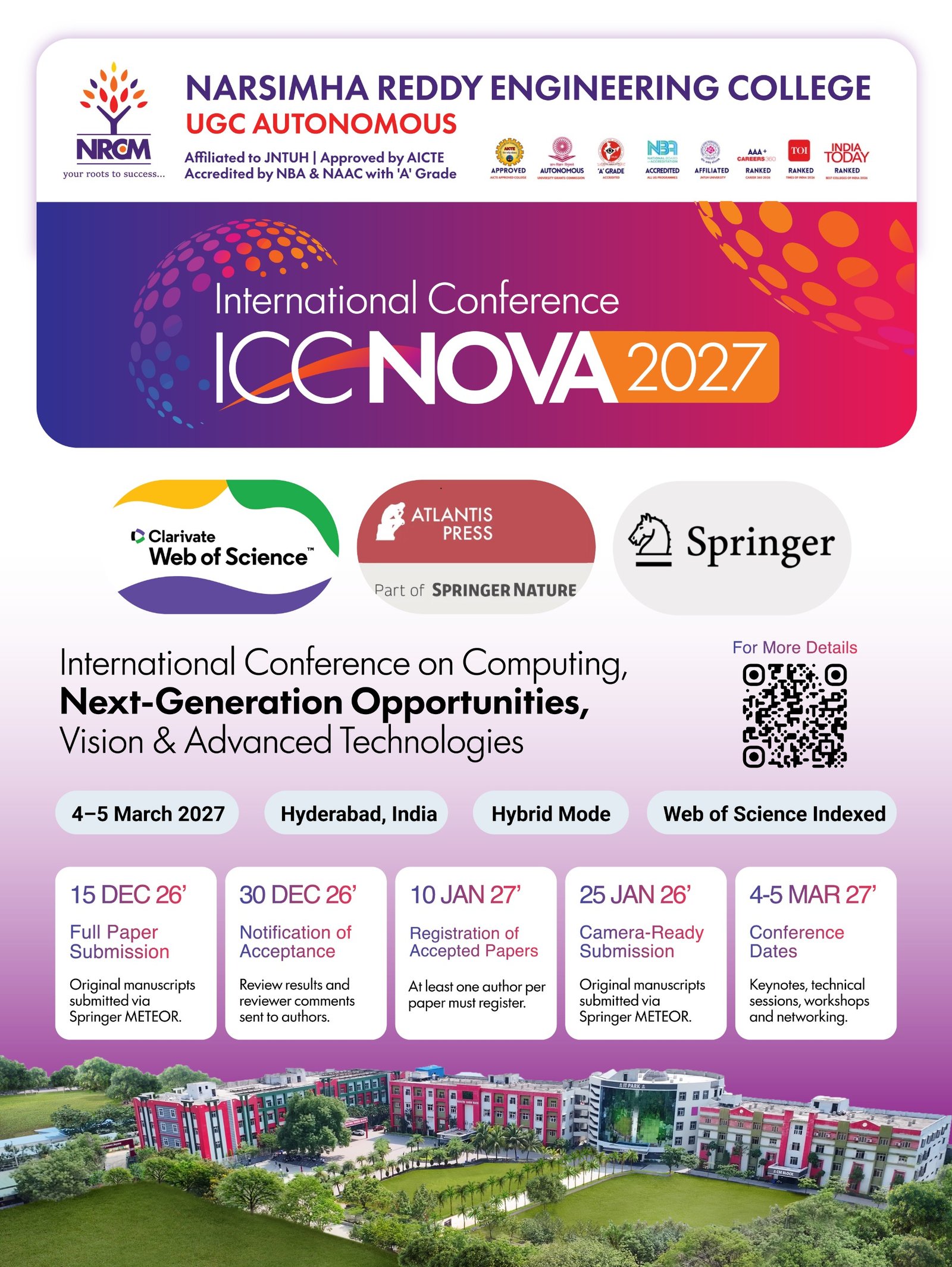
ICCNOVA 2027 official conference poster – 4–5 March 2027, NRCM Hyderabad
Official Conference Poster
Narsimha Reddy Engineering College campus, venue of ICCNOVA 2027 in Hyderabad
Narsimha Reddy Engineering College
Featured Video
Call for Papers

Call for Papers 2027 – Submit Your Research

ICCNOVA 2027 invites original, unpublished research papers and industry case studies for its international conference in Hyderabad, India on 4–5 March 2027. Topics include artificial intelligence and generative AI, data science, cybersecurity, IoT, VLSI, communication engineering, power systems and robotics. Accepted papers are considered for Atlantis Press (Springer Nature) proceedings. The full paper deadline is 15 December 2026. Identify the track that suits your work among the 10 technical tracks and submit through METEOR.

10 Technical Tracks · 125+ Topics Author Guidelines →
01

Artificial Intelligence, Machine Learning & Generative AI

11 topics
  • Artificial Intelligence and Machine Learning
  • Deep Learning and Neural Networks
  • Generative AI and Large Language Models
  • AI Agents and Autonomous AI
  • Reinforcement Learning
  • Explainable and Trustworthy AI
  • Responsible and Ethical AI
  • Federated Learning and Edge AI
  • AI for Healthcare, Education, Agriculture and Finance
  • AI‑based Decision Support Systems
  • AI for Robotics and Autonomous Systems
02

Data Science, Big Data & Intelligent Analytics

12 topics
  • Data Science and Data Engineering
  • Big Data Analytics
  • Data Mining and Knowledge Discovery
  • Predictive and Prescriptive Analytics
  • Business Intelligence
  • Statistical and Computational Learning
  • Data Visualization
  • Data Warehousing and Data Lakes
  • Data Quality and Data Governance
  • Real‑time and Streaming Analytics
  • Graph Analytics
  • Healthcare and Financial Data Analytics
03

Cybersecurity, Privacy & Digital Forensics

13 topics
  • Network and Information Security
  • Cyber Threat Intelligence
  • Intrusion Detection and Prevention
  • AI/ML for Cybersecurity
  • Blockchain Security
  • Cryptography and Post‑Quantum Cryptography
  • Cloud and IoT Security
  • Zero‑Trust Security
  • Digital Forensics
  • Mobile and Wireless Security
  • Privacy‑Preserving Computing
  • Secure AI and Adversarial Machine Learning
  • Critical Infrastructure Security
04

Computer Science, Software Engineering & Emerging Computing

13 topics
  • Software Engineering and Architecture
  • Algorithms and Computational Theory
  • Programming Languages
  • Software Testing and Quality Assurance
  • DevOps and DevSecOps
  • Cloud Computing
  • Edge and Fog Computing
  • Distributed and High‑Performance Computing
  • Quantum Computing
  • Blockchain and Distributed Ledger Technologies
  • Human–Computer Interaction
  • Virtual, Augmented and Mixed Reality
  • Green and Sustainable Computing
05

Computer Networks, IoT & Intelligent Systems

13 topics
  • Computer Networks and Network Architecture
  • 5G/5G‑Advanced and 6G
  • Software‑Defined Networking
  • Network Function Virtualization
  • Internet of Things
  • Industrial IoT
  • Wireless Sensor Networks
  • Edge Intelligence
  • Cyber‑Physical Systems
  • Digital Twins
  • Smart Cities and Smart Infrastructure
  • Intelligent Transportation Systems
  • Cloud–IoT Integration
06

Electronics, VLSI, Embedded Systems & Hardware

12 topics
  • VLSI Design and Testing
  • FPGA and SoC Design
  • RISC‑V and Advanced Processor Architectures
  • Nanoelectronics
  • Low‑Power and Energy‑Efficient VLSI
  • Embedded Systems
  • Embedded AI / TinyML
  • Hardware Security
  • Sensors and MEMS
  • Semiconductor Devices
  • Electronic System Design
  • Robotics and Embedded Intelligence
07

Communication Engineering, Signal Processing & RF Systems

14 topics
  • 5G/6G Wireless Communication
  • Wireless Sensor Networks
  • Massive MIMO and Beamforming
  • Intelligent Reflecting Surfaces
  • RF and Microwave Engineering
  • Antenna Design
  • Millimeter‑Wave and Terahertz Communication
  • Satellite and Space Communication
  • Optical Communication
  • Cognitive Radio
  • Signal and Image Processing
  • Speech and Audio Processing
  • Information Theory and Coding
  • AI‑enabled Communication Systems
08

Electrical Engineering, Power Systems & Power Electronics

14 topics
  • Smart Grid Technologies
  • Renewable Energy Systems
  • Solar and Wind Energy
  • Power Electronics
  • Power Quality and Power Management
  • Electric Vehicles and Charging Infrastructure
  • Battery Management Systems
  • Energy Storage Technologies
  • Microgrids and Distributed Generation
  • AI/ML for Power Systems
  • Smart Energy Management
  • Energy Forecasting
  • High‑Voltage Engineering
  • Sustainable Energy Systems
09

Control, Automation, Robotics & Industry 4.0

13 topics
  • Control Systems and Automation
  • Industrial Automation
  • Robotics and Intelligent Robotics
  • Autonomous Systems
  • Machine Vision
  • Industrial IoT
  • Industry 4.0 and Industry 5.0
  • Digital Twins
  • Predictive Maintenance
  • Intelligent Manufacturing
  • Human–Robot Collaboration
  • Autonomous Vehicles
  • Drone/UAV Technologies
10

Emerging Interdisciplinary Technologies

12 topics
  • AI for Healthcare and Biomedical Engineering
  • AI for Agriculture and Smart Farming
  • AI for Climate and Sustainability
  • Smart Cities
  • Intelligent Transportation
  • Digital Healthcare
  • Bioinformatics and Computational Biology
  • FinTech and Intelligent Financial Systems
  • Quantum AI
  • Metaverse and Extended Reality
  • Green Technology
  • Sustainable Digital Transformation
For Authors

Author Guidelines

Please read these instructions carefully before preparing and submitting your manuscript to ICCNOVA 2027.

Publisher Guidelines ↗

Submission Process

1

Prepare

Format your paper using the publisher’s template (Atlantis Press / Springer Nature) . Papers must be in English and submitted as a PDF.

2

Submit

Upload your manuscript through METEOR — the online submission and peer‑review system — and complete all author and affiliation details.

3

Review

Every submission receives at least 3 independent peer reviews. You can track the status of your manuscript in METEOR.

4

Camera‑Ready

After acceptance, register, address reviewer comments, and upload the final camera‑ready paper by the deadline.

Manuscript Preparation

Structure

Length & Structure

The manuscript must be 8 to 12 pages formatted strictly using the Atlantis press Springer Nature template. Include title, abstract, keywords, methodology, results and references.

Integrity

Originality & Plagiarism

Only original, unpublished work not under consideration elsewhere will be accepted. All papers are screened for plagiarism and self‑plagiarism; similarity must remain within acceptable limits.

Presentation

Registration & Presentation

At least one author of each accepted paper must register and present the work — in person or online. Papers not presented may be excluded from the proceedings.

Ethics

Ethics & Conflicts

Authors must disclose funding sources and conflicts of interest, cite sources appropriately, and follow the publisher’s ethics and misconduct policies.

Questions about formatting or eligibility? Write to iccnova2027@nrcmec.org.

Poster

Poster Presentation

The ICCNOVA 2027 conference invites UG and PG students to participate in the Poster Presentation Session and showcase their innovative research contributions.

Authors of accepted papers may present their research findings through scientific posters, highlighting the research objectives, proposed methodology, experimental results, and key contributions. The poster presentation session provides an opportunity for researchers to interact with experts, exchange ideas, receive valuable feedback, and establish research collaborations. Posters will be evaluated by the designated session chairs/judges based on originality, technical contribution, research methodology, presentation quality, clarity of communication, and interaction with the audience.

Timeline

ICCNOVA 2027 Important Dates & Deadlines

Please mark your calendar — all sessions run in hybrid mode (in‑person and online).

  1. Full Paper SubmissionOriginal manuscripts submitted via METEOR.
    15 December 2026
  2. Notification of AcceptanceReview results and reviewer comments sent to authors.
    30 December 2026
  3. Registration of Accepted PapersAt least one author per paper must register.
    10 January 2027
  4. Camera‑Ready SubmissionFinal, revised papers formatted to publisher guidelines.
    25 January 2027
  5. Conference DatesKeynotes, technical sessions, workshops and networking.
    4–5 March 2027

All deadlines close at 23:59 IST. Detailed programme schedule coming soon.

Registration

ICCNOVA 2027 Registration Fees

Registration opens after acceptance notifications on 30 December 2026. At least one author of every accepted paper must register and present the work — in person or online.

Registration Fee

Author Category Authors from IndiaRegistration (INR) Authors from Outside IndiaRegistration (USD)
Academicians, Research Scholars, Industry / R&D, UG and PG Students ₹ 9,000+ 18% GST USD 200
Proceedings ₹ 4,000+ 18% GST USD 100
Listener with Certificate for Co‑Author RegistrationResearch scholars and others ₹ 2,000+ 18% GST USD 40
Poster Presentation for UG & PG Students ₹ 500+ 18% GST USD 20
Listener with Certificate for UG & PG Students ₹ 500+ 18% GST USD 20

Important Notes

  1. Registration fee towards the conference includes online conference proceedings, presentation during the conference (online or offline), attendance to all the sessions, and keynote talks.
  2. The conference will be held offline or online on Day 1 & Day 2. All offline participants must manage their own stay and travel; the conference organizers are not responsible for travel and accommodation. Only tea/coffee, high tea and working lunch on Day 1 & Day 2 will be provided at the conference venue.
  3. Abstract / Short Paper / Poster will not be published in the Conference Proceedings.
  4. Refund and Cancellation Policy: A candidate once registered and having paid the registration fee is not allowed to cancel the registration. The registration fee, once paid, is not refundable.

Best Paper Award Guidelines

To ensure a fair and transparent selection process for the Best Paper Awards, the following guidelines will be followed.

Eligibility

Eligibility Criteria

All submitted papers must be original, unpublished, and presented at the conference. At least one author must register, attend the event and present the accepted paper. Submissions are welcome from academic institutions and industry professionals. For student papers, the first author must be a student.

Evaluation

Evaluation Criteria

Selection is based on five criteria: technical depth and novelty; relevance to conference themes, methodology and experimental results; clarity of presentation and writing; and impact and practical applications. Papers are evaluated by the assigned reviewers, and the Technical Program Committee makes the final acceptance decision.

Selection

Selection Process

Session chairs and judges evaluate each paper on technical content, quality of presentation, communication skills and overall performance, and assign scores. Papers are shortlisted on these scores, and the highest‑scoring paper in each track is considered for the Best Paper Award.

Recognition

Announcement & Recognition

Winners will be announced during the closing ceremony. Each award recipient receives a certificate of achievement, and the winners will be recognized and highlighted on the official conference website.

For invoices, group bookings or payment queries, write to iccnova2027@nrcmec.org.

People

ICCNOVA 2027 Organizing Committee

Chief Patrons

Shri. J Narsimha Reddy
Shri. J Narsimha ReddyChairman, NRCM
Shri. J Trishul Reddy
Shri. J Trishul ReddySecretary, NRCM
Shri. J Thrilok Reddy
Shri. J Thrilok ReddyTreasurer, NRCM

Patrons

Dr. A Mohan
Dr. A MohanDirector, NRCM
Dr. R Lokanadham
Dr. R LokanadhamPrincipal, NRCM

Convenor & Co‑Convenors

Dr. N Rajasekhar
Dr. N RajasekharConvenor · Professor, CSE
Dr. P Dileep Kumar Reddy
Dr. P Dileep Kumar ReddyProfessor & Dean R&D, CSE
Dr. P Ramesh Babu
Dr. P Ramesh BabuProfessor & HoD, CSE
Dr. G S Naveen Kumar
Dr. G S Naveen KumarProfessor, CSE

Organizing Chairs

Dr. Ramalinga Swamy CherukuNIT Warangal, India
Dr. T Senthil KumarDr. ACS College of Engg., Bengaluru
Dr. D KoteswaraoNRCM
Dr. S MallikarjunaiahNRCM
Prof. D SrinivasNRCM

Editors

Dr. V Purandhar ReddyNRCM
Dr. G Naga JyothiNRCM
Dr. G Rajesh KumarVNRVJIET
Dr. G Srinivas RaoVNRVJIET

Organizing Team

Dr. C SasikalaNRCM
Dr. K AnuradhaNRCM
Dr. N KavithaNRCM
Dr. K Purushotham PrasadNRCM
Prof. M SowmyaNRCM
Prof. G V VaraprasadNRCM
Dr. D Simhana DeviNRCM
Prof. D VenkateshNRCM
Dr. P NagarajaNRCM
Prof. N KiranmaiNRCM
Dr. P Venkat RaoNRCM
Dr. N Aditya ValliNRCM
Dr. M ShobanNRCM
Dr. N Srinivasa RaoNRCM

National Advisory Committee

Distinguished academicians, researchers and industry experts from reputed institutions across India.

Dr. Jimson Mathew

Indian Institute of Technology, Patna, India

Dr. Rajeev Srivastava

Indian Institute of Technology (BHU), Varanasi, India

Dr. Damodar Reddy

National Institute of Technology Goa, India

Dr. Ramesh Dharavath

Indian Institute of Technology (ISM), Dhanbad, India

Dr. Amgoth Tarachand

Indian Institute of Technology (ISM), Dhanbad, India

Dr. N. Ramakrishnaiah

Jawaharlal Nehru Technological University, Kakinada, India

Dr. K. Shahu Chatrapati

Jawaharlal Nehru Technological University, Hyderabad, India

Dr. B. V. Ramnaresh Yadav

Jawaharlal Nehru Technological University, Hyderabad, India

Dr. D. Vasumathi

Jawaharlal Nehru Technological University, Hyderabad, India

Dr. J. Ujwala Rekha ↗

Jawaharlal Nehru Technological University, Hyderabad, India

Dr. C. Shoba Bindu

Jawaharlal Nehru Technological University, Ananthapuramu, India

Dr. R. Rajeshwararao

Jawaharlal Nehru Technological University, Kakinada, India

Dr. N. C. Naveen

Ramaiah Institute of Technology, Bengaluru, India

Dr. K. Rajendra Prasad

Amity University, Hyderabad, India

Dr. V. Suma

Dayananda Sagar College of Engineering, Bengaluru, India

Dr. J. Rajeshwari

Dayananda Sagar College of Engineering, Bengaluru, India

Dr. M. Suresh Kumar

Dayananda Sagar College of Engineering, Bengaluru, India

Dr. K. Prasanna Lakshmi

Gokaraju Rangaraju Institute of Engineering and Technology, Hyderabad, India

Dr. K. Madhavi

Gokaraju Rangaraju Institute of Engineering and Technology, Hyderabad, India

Dr. B. Sankara Babu

Gokaraju Rangaraju Institute of Engineering and Technology, Hyderabad, India

Dr. Arun Nagaraja

Quick Heal Technologies Limited, Bengaluru, India

Dr. Ch. A. S. Murty

Centre for Development of Advanced Computing (C-DAC), Hyderabad, India

Dr. G. Padmavathi

CRRAIMSCS, University of Hyderabad Campus, Hyderabad, India

Keynotes

ICCNOVA 2027 Keynote Speakers

Learn from global leaders shaping the future of AI, cloud and precision medicine.

CS

Dr Chandan Srinivasan

Data Scientist, Microsoft
Frontiers of Generative AI

Principal Data Scientist in Hyderabad leading Responsible AI initiatives for Asia, with a decade of experience in AI solution architecture and predictive modelling.

DE

Dr Damodar Reddy Edla

Associate Professor, NIT Goa
AI in Precision Medicine

250+ research articles and 15 granted patents in Brain Computer Interface and Sensors.

RD

Dr. Ramesh D. H N

Associate Professor, IIT (ISM) Dhanbad
Building Resilient Cloud Architectures

Specializes in distributed computing, cloud security, Big Data and Blockchain.

Partners

Sponsors

We gratefully acknowledge the support of our sponsors.

CSI Hyderabad Chapter logo, sponsor of ICCNOVA 2027
Quick Answers

ICCNOVA 2027 – Frequently Asked Questions

What is ICCNOVA 2027?

ICCNOVA 2027 is the International Conference on Computing, Next-Generation Opportunities, Vision and Advanced Technologies, hosted by Narsimha Reddy Engineering College (NRCM), Hyderabad, India. It is held in hybrid mode on 4–5 March 2027.

When and where is ICCNOVA 2027?

ICCNOVA 2027 takes place on 4–5 March 2027 at Narsimha Reddy Engineering College, Maisammaguda, Kompally, Secunderabad, Telangana, India, with online participation also available.

What is the ICCNOVA 2027 paper submission deadline?

The full paper deadline is 15 December 2026. Acceptance notification is 30 December 2026, registration closes 10 January 2027, and camera-ready papers are due 25 January 2027. All deadlines close at 23:59 IST.

Where are ICCNOVA 2027 papers published?

Accepted and presented papers are considered for the open-access proceedings Advances in Intelligent Systems and Research, published by Atlantis Press, part of Springer Nature, with an ISBN. The proceedings will be submitted for consideration for Web of Science indexing, subject to the indexer's evaluation.

How do I submit a paper to ICCNOVA 2027?

Submit your original manuscript (8 to 12 pages, Atlantis Press / Springer Nature template, English, PDF) through the METEOR system at meteor.springer.com/ICCNOVA2027. Each paper receives at least three independent peer reviews.

How much is ICCNOVA 2027 registration?

For authors from India, registration is INR 9,000 plus 18% GST; for authors from outside India it is USD 200. Lower fees apply for listeners and student poster presentations.

What topics does ICCNOVA 2027 cover?

Ten tracks: AI/ML and Generative AI; Data Science; Cybersecurity; Computer Science and Software Engineering; Networks and IoT; VLSI and Embedded Systems; Communication Engineering; Power Systems; Control, Robotics and Industry 4.0; and Emerging Interdisciplinary Technologies.

Can I attend ICCNOVA 2027 online?

Yes. The conference runs in hybrid mode, and authors may present in person or online.

More questions? See the full FAQ page or write to iccnova2027@nrcmec.org.

Plan Your Visit

Venue & Location – NRCM, Hyderabad

Venue

Conference Venue

Narsimha Reddy Engineering College (UGC Autonomous),
Maisammaguda (V), Kompally, Secunderabad – 500100,
Telangana, India.

View on Google Maps →